
From the archive
Standard zoom or one prime? Start with a Nikon Z DX example
Compare the NIKKOR Z DX 16–50 mm VR and 24 mm f/1.7 by framing flexibility, aperture and the space you can actually use.
The Camera Notebook ·
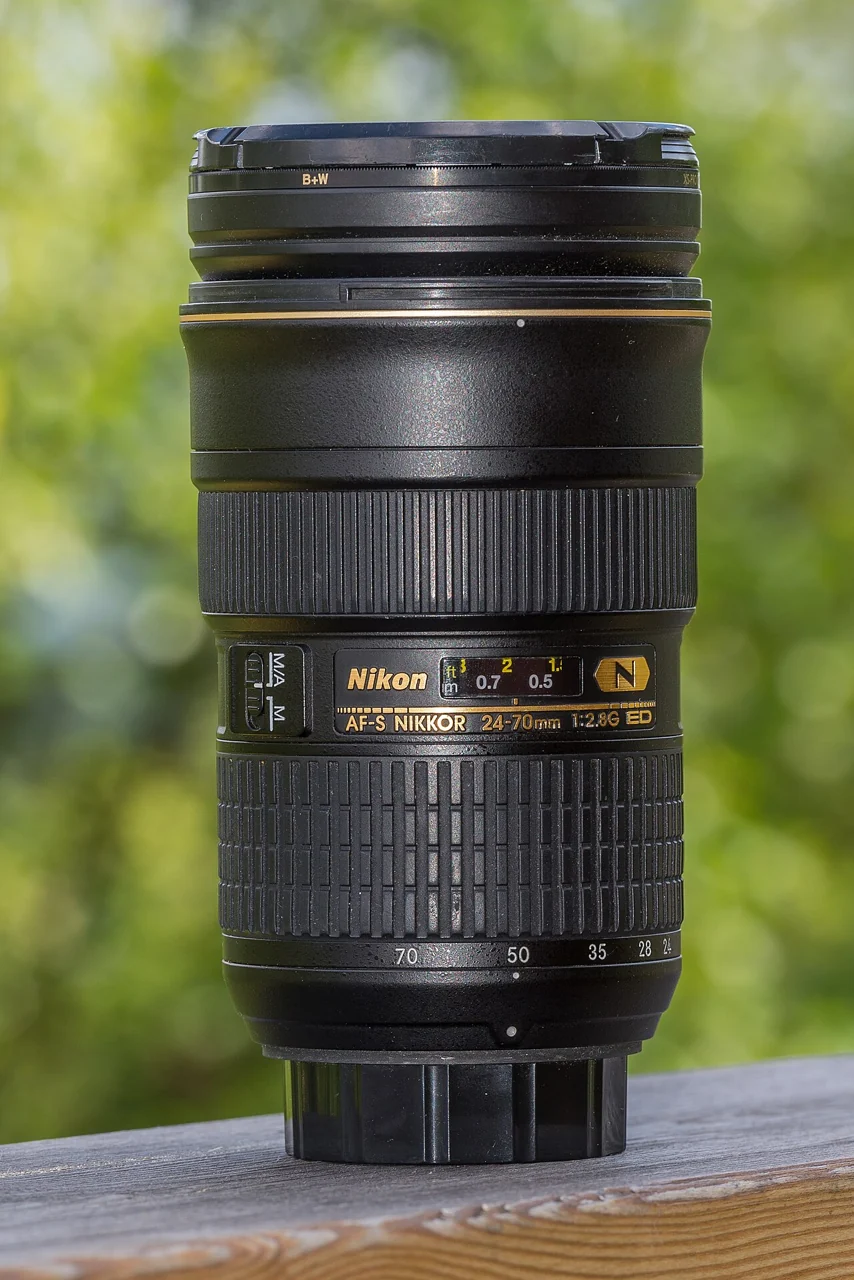
A useful lens comparison starts with the frame you missed. Was the room too small, the shutter speed too slow, or the kit too awkward to carry? Those are different problems. This guide uses two documented Nikon Z DX lenses to show how to separate them. The photograph above shows a different, explicitly identified Nikon AF-S lens; it is an editorial reference for reading a barrel, not a photograph of either compared lens.
Two lenses, two different kinds of flexibility
Nikon identifies the 16–50 mm f/3.5–6.3 VR as a DX-format Z-mount zoom with optical vibration reduction, and the 24 mm f/1.7 as a fixed-focal-length DX Z prime. This comparison concerns those named versions, rather than the newer 16–50 mm f/2.8 or a similarly named F-mount lens. Their specifications tell you what to try; they do not establish a winner in image quality.
| Question | 16–50 mm f/3.5–6.3 VR | 24 mm f/1.7 |
|---|---|---|
| Can you change framing without moving? | Variable focal length from 16 to 50 mm. | One actual focal length: 24 mm. |
| What is the maximum aperture? | Varies across the zoom range; do not assume f/3.5 at every setting. | f/1.7. |
| What is the system? | Nikon Z mount, DX coverage. | Nikon Z mount, DX coverage. |
| What should you rehearse? | A route needing both wider and tighter compositions. | A route at 24 mm actual before considering its other properties. |
Make the same-view comparison first
If you already own a compatible zoom, set it to 24 mm. Keep your position for a few pictures so that changing the frame does not quietly become changing the viewpoint. On nominal 1.5× Nikon DX, that setting corresponds to about 36 mm on the full-frame framing reference. It remains a 24 mm lens setting. Use the framing lab to rehearse the edges, then check what your real room allows.
Write down what the zoom cannot demonstrate
The trial can reveal that you like that angle, or that backing up would mean standing in a wall. It cannot demonstrate a particular prime’s autofocus, flare resistance, rendering or performance at f/1.7. A wider aperture can give you another exposure choice, with depth-of-field consequences. Before buying for a dim room, read your existing photo’s aperture, shutter speed and ISO and identify which compromise bothered you.
Decide with a sentence you can act on
Try “I need the wider end for our small kitchen” or “I repeatedly use 24 mm and want to explore a wider aperture.” If neither describes a real constraint, keep the zoom and continue the exercise. Check the exact body’s support, current firmware and package contents separately. The longer prime rehearsal gives you a repeatable route; the lens catalog preserves the selected product identities. This is a manufacturer-based comparison, without hands-on test results.
Sources
Related equipment and reading
These are the two exact Nikon Z DX lens references discussed in the article. Confirm your body before considering either.
As an Amazon Associate I earn from qualifying purchases. These are optional references, not product tests or live offers.
NIKKOR Z DX 16–50 mm VR · Black · USA model
The identified Nikon Z DX 16–50 mm zoom from this comparison. Confirm a supported Nikon Z body and the exact regional package.
The DX VR zoom for compatible Nikon Z bodies. Keep it separate from the newer f/2.8 lens and renewed or accessory bundles.
NIKKOR Z DX 24 mm f/1.7 · Black · USA model
The Nikon Z DX 24 mm f/1.7 prime from this comparison. This reference is for compatible Nikon Z DX bodies, not another mount.
A DX-format Nikon Z prime. Rehearse the focal length on a compatible zoom before adding another lens.
Lens and mount checks · Rehearse on a kit zoom · Try the field exercise